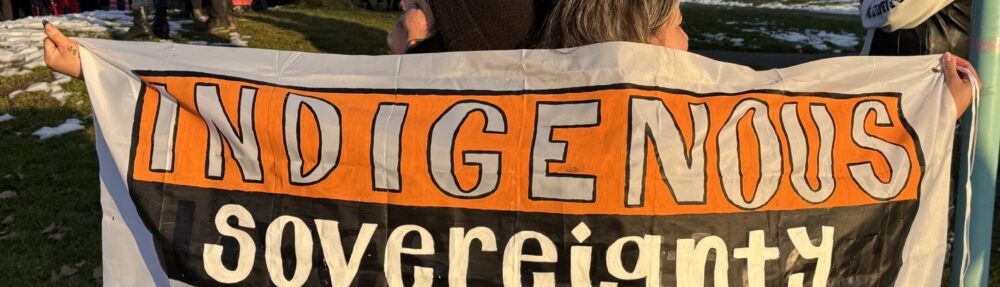
This artifact showcases my Indigenous pedagogy assignment, where I explored the “Strong Like Two People” framework and designed a classroom approach for Grade 3 implementation.
C.Lafferty-EDEF-3200-Indigenous-Pedagogy-presentation
I chose the “Strong Like Two People” framework because it connects closely to my own experiences growing up between two different ways of learning and being. I learned about this framework through the Chief Jimmy Bruneau School (CJBS) in Behchokǫ̀, NT, where I attended from Kindergarten to Grade 2 before moving to Yellowknife. CJBS’s vision is to be “Strong Like Two People,” where in addition to academic programming, they offer many culturally responsive programs, including seasonal camps, Tłı̨chǫ language instruction, and locally developed courses such as drumming, learning about the Tłı̨chǫ Agreement, and beading (Government of the Northwest Territories [GNWT], 2018–2019). Being part of this environment at a young age helped shape how I understand learning and identity.
The philosophy itself comes from the teachings of Chief Jimmy Bruneau, which were later explained by Tłı̨chǫ Elder Elizabeth Mackenzie, who shared that one person could be “like two persons: one, knowing everything of the white culture and one, knowing of our ancestors’ culture. That person would become very strong for if we know everything like two persons… there may be no one greater than us” (Tłı̨chǫ Community Services Agency, 1971/2014). This teaching highlights the importance of learning from both Indigenous and Western knowledge systems in order to become a strong and capable person.
As someone who grew up with both my Indigenous identity and Western schooling, I often felt like I was moving between two separate worlds. Over time, I came to understand that both parts were always a part of me, and learning how to bring them together helped me feel more confident in who I am. Because of this, I value teaching approaches that honour both Indigenous knowledge and Western education rather than separating them.
The “Strong Like Two People” philosophy reflects this idea of balance. It shows that students do not have to choose one way of learning over another, but instead can grow stronger by learning from both. I think this is especially important in a Grade 3 classroom, where students are still developing their sense of identity and belonging. At this age, it is important that students feel seen, valued, and connected to their culture, community, and classroom environment.
My hope for implementing this framework is to create a classroom where all students feel like they belong and where different ways of knowing are respected. I want students to learn through relationships, storytelling, and hands-on experiences, while also building important academic skills. I also hope to include community members and Elders in the learning process so that students can hear knowledge directly from those who carry it. Overall, I hope this approach helps students feel proud of who they are while learning how to navigate different ways of understanding the world.